
Suffolk Criminal History Checks
Begin with the event and the custodian. Suffolk Police Central Records holds city incident, arrest, and crash reports plus the Suffolk-only local check. The General District Court holds adult misdemeanor and felony preliminary records. Circuit Court holds felony trials and appeals. Western Tidewater Regional Jail records custody and booking. A broader official Virginia history comes from the Virginia State Police CCRE request process.
- Ask Suffolk Police for the incident or arrest report by report number.
- Check WTRJ when current or recent custody is the question.
- Search Suffolk General District Court for adult misdemeanors and felony preliminary matters.
- Search Suffolk Circuit Court if a felony was indicted, certified, or appealed.
- Use VSP SP-167 for an official consent-controlled Virginia repository response.
Exact spelling matters. The Virginia Judiciary advises using the name as written on the summons, even when it appears misspelled. A full case number is more reliable for a specific file.
One Suffolk City Record Guide
Suffolk is both an independent city and a Census county-equivalent. Virginia's charter records the consolidation of the Cities of Nansemond and Suffolk on January 1, 1974. Holland and Whaleyville are now communities within Suffolk, not separately incorporated cities with their own police departments or courts. That is why one city guide is accurate here.
The consolidation also affects historic searches. Records before 1974 may be indexed under predecessor jurisdictions. Modern Suffolk Police coverage extends across the entire consolidated city. The City describes about 430 total square miles, while Census QuickFacts lists 399.16 land square miles. Those figures measure different things and should not be treated as conflicting record evidence.
The official City of Suffolk site is the main department directory.

Use that directory to confirm current office pages, but send each record request to the department that keeps the file.
Records at Suffolk Police Department
Suffolk Police Department is the city's main criminal-investigative and arrest-report custodian. Central Records is at 111 Henley Place, Suffolk, VA 23434. Records questions go to 757-514-7915; the main police number is 757-514-7900, and nonemergency calls go to 757-923-2350. The department's Request for Information form covers accident reports, incident reports, and a background product at $10 each.
A request may be mailed to Suffolk Police Department, Attn: Central Records, P.O. Box 1678, Suffolk, VA 23439; faxed to 757-514-4225; emailed to centralrecords@suffolkva.us when card payment is used; or taken to headquarters. The form asks for requester contact data, identification, product choice, report number when known, payment, and delivery choice. A listed victim may receive an incident report without charge under the Police FAQ.
Suffolk Police Central Records
111 Henley Place
Suffolk, VA 23434
757-514-7915
Mail, fax, email/card, or counter request
Suffolk Police Record Geography
Suffolk Police allocates 200 full-time sworn positions and divides patrol into 17 zones, with ten in Sector I and seven in Sector II. That decentralized plan covers rural, suburban, and urban territory. A precise location, report number, date, and responding unit can make a records request much more useful than a broad reference to downtown or a neighborhood name.
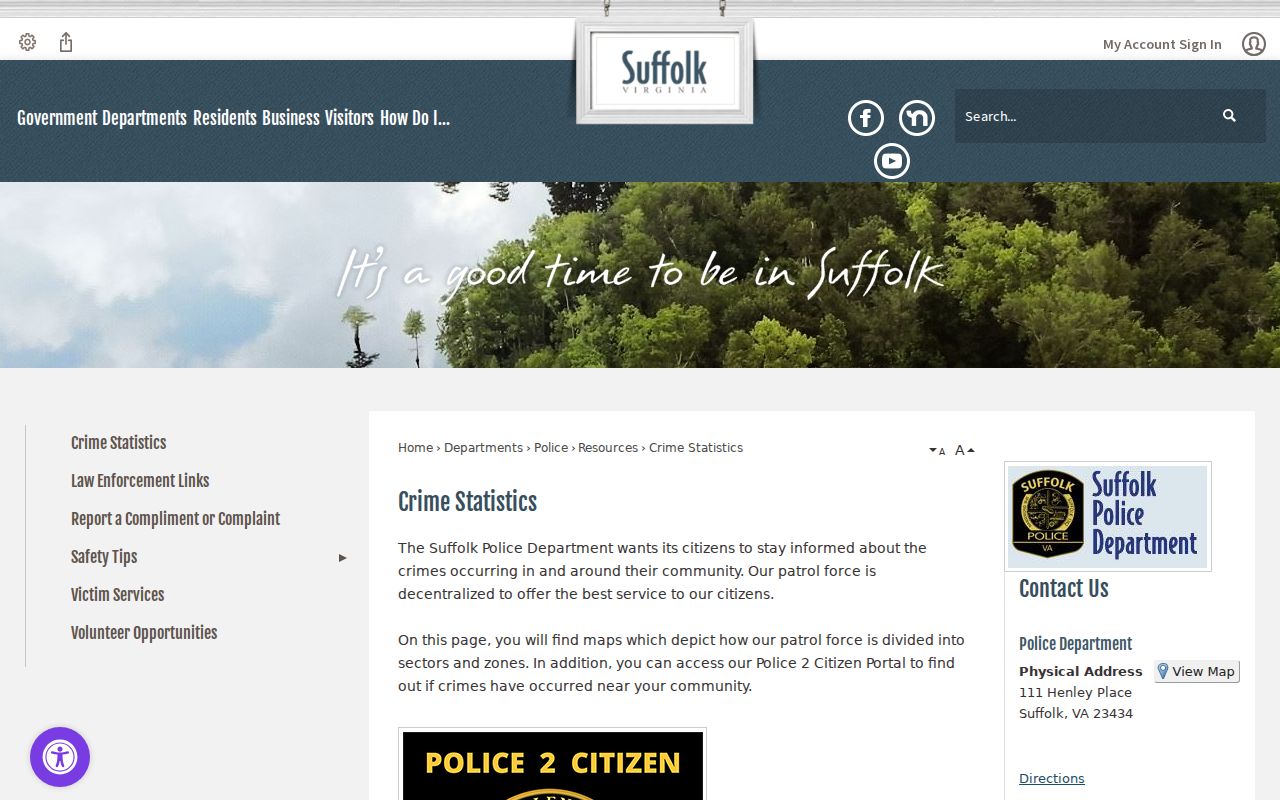
The Suffolk Crime Statistics page links precinct maps and Police2Citizen geographic incident information.
Police2Citizen supports awareness of reported events. It is not a final criminal history, a complete daily arrest log, or proof that a court convicted anyone.
Booking and Arrest Records in Suffolk
Suffolk does not run a standalone municipal jail. Police transport arrestees to Western Tidewater Regional Jail at 2402 Godwin Boulevard. WTRJ also serves Franklin and Isle of Wight County, so the official roster is regional. Current custody questions can go to Booking at 757-539-3119 ext. 543. The nearby Suffolk Magistrate operates at all hours for process and initial bail functions.
Three records arise quickly. Suffolk Police writes the arrest report, WTRJ creates the intake and custody entry, and the magistrate records process or bail action. A booking entry may show initial charges, arresting agency, bond or hold, and release. Those facts can change. The Commonwealth's Attorney may file a different charge, and the court later records the disposition.
For deeper arrest access, use the dedicated Suffolk arrest search route, which separates reports, booking, warrants, and court follow-through.
Suffolk Arrest Records Reach CCRE
Four Livescan stations support Suffolk's arrest-reporting chain: Police Headquarters, Precinct 2, the Godwin courthouse, and WTRJ. City public-safety materials described their replacement in 2025 to meet Virginia State Police requirements. Fingerprints from reportable arrests help CCRE connect the arrest cycle to the right identity.
Clerks later report final dispositions. A lag, missing identifier, or failed match can leave an official history without the expected result. A person reviewing their own record should compare the CCRE response with both Suffolk court levels, obtain the final order, and ask the arresting agency to correct source data. VSP expressly sends error questions to that source agency.
Record flow: Suffolk Police › WTRJ and Suffolk Courts › Virginia State Police CCRE
The Suffolk Municipal Court File
Suffolk has no municipal court in the common out-of-state sense. State-operated courts hear the city's cases at the Mills E. Godwin, Jr. Courts Building. General District Court tries adult misdemeanors and traffic cases, conducts felony preliminary hearings, and schedules local City Cases. Circuit Court tries felonies and hears appeals. J&DR handles juvenile delinquency and certain adult family or household matters, with juvenile information closed to public online search.
| Court name | Suffolk General District, Circuit, or Juvenile and Domestic Relations District Court. |
|---|---|
| Case types | Adult misdemeanors, traffic, felony preliminaries, felony trials, appeals, and limited J&DR matters. |
| Lookup channel | Virginia OCIS plus the relevant clerk's public counter. |
| Docket contents | Case number, charge, hearing, status, plea, disposition, sentence, and payment data when public. |
| Copies and fees | Ask the clerk under the statutory schedule; the local source reviewed did not state one exact criminal-copy price. |
All three clerks work at 150 North Main Street, but they keep separate files. Circuit Clerk hours are 8:30 a.m. to 5 p.m., with register and money transactions ending at 4:30. GDC and J&DR clerk hours are 8 a.m. to 4 p.m.
Suffolk Court Records Split Three Ways
A summons or warrant should name the court. That label is the first routing clue. GDC is the usual first stop for a misdemeanor or a felony preliminary record. A felony that is certified or indicted moves toward Circuit Court and may receive a new case number. Direct indictment can create a Circuit record without a public preliminary path.
Online court data is an index and status service, not always the full file. Call Circuit at 757-514-7800, GDC at 757-514-4822, or J&DR at 757-514-7790. Bring a case number for copy or inspection questions. A City FOIA request is not a substitute for the clerk's judicial-record process.
How Suffolk Records Reach Virginia
A recent city event is most detailed at Suffolk Police. Booking and bond are most current at WTRJ. Once a criminal charge is filed, the court docket becomes the best source for prosecution and outcome. CCRE is the official state repository layer. It aggregates reportable, identity-linked arrest cycles and dispositions but does not contain every report narrative or docket document.
Record flow: Suffolk Police › Suffolk GDC or Circuit Court › Virginia State Police CCRE
Timing controls the best first stop. Use Police or WTRJ for a recent event, the court for a filed or completed case, and VSP for a consent-controlled Virginia response. Search both GDC and Circuit when a felony may have moved between levels.
Historic Suffolk Criminal Record Gaps
Suffolk's record history reaches beyond modern portals. The Sheriff's history recounts fires in 1779, 1837, 1885, and 1888. The Great Fire of 1837 destroyed the courthouse, clerks' offices, and most vital records. Researchers looking far back may face a true archival gap rather than a search failure. The current Godwin Courts complex was dedicated in 1998.
The 1974 consolidation adds another indexing issue. Older papers may refer to Nansemond County or a predecessor locality. A searcher doing genealogy or historic case research should provide date, place, name variants, and the likely former jurisdiction to the clerk or archive. A modern Suffolk name search cannot restore material that the fire destroyed.
Suffolk Record Access Rules
Virginia law separates police, court, repository, and registry access. VFOIA lets eligible requesters seek reasonably described existing city records, but sensitive investigative and victim information can be withheld or redacted. Court clerks use judicial access statutes and rules. CCRE dissemination is limited to authorized purposes and consent routes. Juvenile and sealed files remain restricted.
Key statutes:
Virginia Freedom of Information Act sets the local public-record request framework.
Va. Code § 2.2-3706 governs law-enforcement records and sensitive exemptions.
Va. Code § 17.1-208 covers clerk inspection and copies of nonconfidential court records.
Va. Code § 19.2-389 limits release of state criminal-history information.
A request should describe a report, date range, incident, or file number. Agencies need not create a new record or answer a question that asks for legal research.
Suffolk Crime Records Need Context
The City Statistical Digest reports a total-crime rate that moved from 28.2 per 1,000 in 2018 to 18.8 in 2024. The source uses mixed official attribution, which should be preserved rather than restated as a single pure federal series. A rate is not a count of defendants, bookings, or convictions. Population growth and reporting coverage also affect comparison.
Census estimated 103,105 Suffolk residents in 2024, up 9.2 percent from the 2020 estimate base. Police2Citizen map points can mark calls or classified events, not guilt. Camera citations used in Suffolk school, red-light, and work-zone programs may be civil enforcement records rather than criminal convictions. Always follow an event to the court disposition before drawing a criminal-history conclusion.
Local court volume needs the same care. Suffolk J&DR reported 1,402 adult-criminal filings in 2025, compared with 1,267 in 2024. A filing is a workload event, not a unique person or a conviction. It may also involve a family or household matter that falls within J&DR jurisdiction. Use the case's own public status and final order instead of applying the annual count to any individual Suffolk record.
Suffolk Police Record Forms
The main information request asks for requester name and contact data, identification, the chosen report product, a report number when known, payment information, signature when needed, and email, mail, or fax delivery. The local check form separately asks for the subject's identifying data, signed permission, and notarial certificate. It expressly limits its scope to Suffolk.
| Form or system | Core fields | Meaning |
|---|---|---|
| SPD Request for Information | Contact, ID, product, report number, payment, delivery | City report or local product |
| SPD Local Record Check | Subject names, descriptors, DOB, birthplace, consent, notary | Suffolk files only |
| Virginia OCIS | Court, name, case number, hearing date | Public adult court status |
| WTRJ custody search | Current live name or identifier choices | Regional custody, not full history |
No official Suffolk Police or Sheriff app was verified as an app-only record, warrant, or jail search. Vendor mobile pages should not be mislabeled as agency apps.
When a Suffolk result appears wrong, preserve the report or case number and compare the source files. Suffolk Police controls corrections to its incident and arrest data. The Suffolk clerk controls the court docket and final order. VSP directs a person disputing a CCRE entry to the arresting agency that supplied the data. If the issue is a missing court outcome, obtain the Suffolk disposition first, then follow the secure correction instructions provided by the source office. A blank Police2Citizen or OCIS result alone does not prove that no Suffolk record exists.